Why Your Online Shop Isn’t Making Sales — And Which of the 4 Bottlenecks Is Yours
Free. Arrives immediately.
When a shop is stuck under $1,000/month, the cause is almost never “everything.” It’s one of four things: not enough qualified people reach your product (traffic), they arrive but don’t buy (offer), your platform or tracking hides what’s actually happening (platform), or the market you picked doesn’t have enough buyers (market). Fixing the wrong one is why effort stops producing results. You can usually tell them apart with three numbers you already have: monthly visits, conversion rate, and revenue per visitor.
How do you tell which bottleneck is yours?
Work through these in order. The first one that’s true is your bottleneck — stop there.
- You can’t answer the questions below because your analytics aren’t installed, your Etsy and website data don’t reconcile, or you’ve never checked → the platform is your bottleneck. Nothing else can be diagnosed until you can see.
- Fewer than 50 visitors a month → traffic is your bottleneck. Below this, conversion rate is statistical noise. Optimizing your product page here is guesswork.
- Enough sessions, but conversion below 0.5% → the offer is your bottleneck. People are arriving and leaving. In my experience, this is almost always trust, not product quality — the shop looks like it might not be real.
- Decent traffic, decent conversion, revenue still flat → market is your bottleneck. You’re converting the few buyers who exist. There aren’t enough of them at your price.
The order matters. Sellers overwhelmingly start at #3 — rewriting descriptions, retaking photos — when they’re actually stuck at #1 or #2.
Is traffic your bottleneck?
Your site gets 5, 20, maybe 30 visitors a month, and they arrive by accident — a direct link, a stray click, an old social post. There’s no signal, only noise. Offer tweaks won’t help. Platform changes won’t help. A perfect product wouldn’t sell under these conditions.
Is your offer the bottleneck?
People do arrive. They land on the product page, they stay a while, they click — and they don’t buy. That gap isn’t accidental, and more traffic won’t fix it. It would only make the rejection more visible.
Is your platform the bottleneck?
You have traffic. You may even have occasional sales. But you don’t trust the numbers, and you don’t know where people drop off. One change seems to help, the next breaks something else. Nothing compounds, because nothing is measurable.
Is the market your bottleneck?
Sales are thin across every channel. There’s interest but no follow-through. No product stands out, no matter how many you launch. This is the hardest result to accept — and the most expensive one to ignore.
Why does “trying everything” stop working under $1,000/month?
Because at this stage you have enough moving parts to break something and not enough volume to tell what broke. With a few sales a month, every change looks like it might have worked. That’s the trap: effort feels productive, results stay flat, and eventually the website gets left to sit — again.
Most advice online is written for two groups you’re not in: absolute beginners who haven’t launched, and sellers already doing $10,000–30,000 a month. The middle stage — already selling, working around a full-time job, aiming for a realistic $1,000–3,000 a month — gets almost nothing written for it. That gap is what this diagnostic is for.
What you’ll walk away with
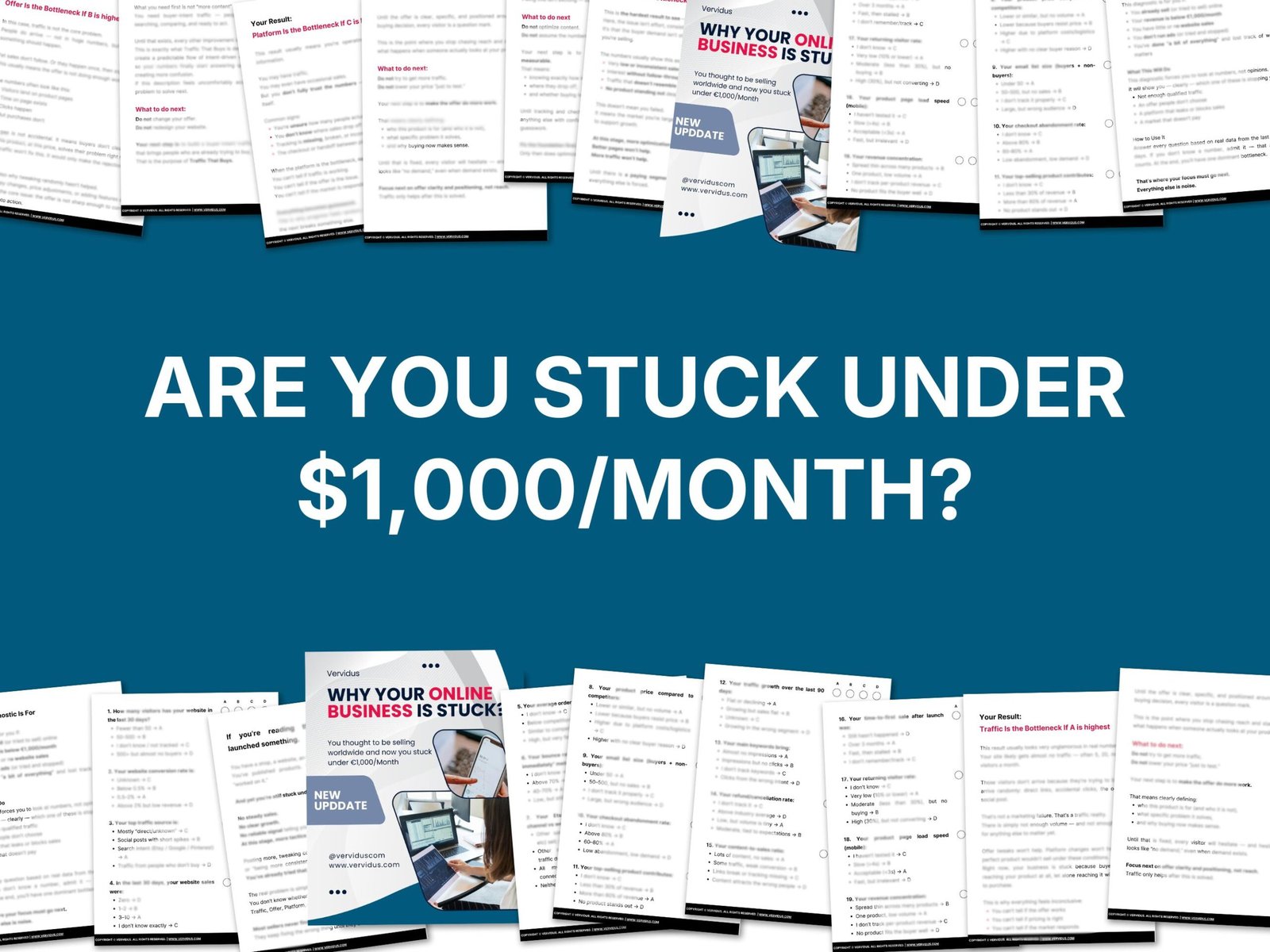
Twenty questions, answered from your own numbers — not opinions, not guesses. At the end you have one letter, and that letter tells you the single thing to work on next.
It also tells you what to stop doing. That part is usually worth more.
Most people find their result uncomfortable. That’s normally the sign it’s right.
Who is this for?
Sellers who have already launched — usually on Etsy — are doing real but inconsistent sales under $1,000 a month, and want one clear answer instead of another list of tactics. It assumes you have a shop or website live and are willing to look at your actual numbers.
It’s not for you if you haven’t launched yet, you’re looking for motivation, or you’d rather not check your data.
About Vervidus
Vervidus makes practical tools for Etsy sellers and small online shops — checklists, trackers, and guides built around one question: why do buyers trust some shops and walk away from others? Every tool draws on 11 years of hands-on e-commerce across Etsy, Shopify, Amazon, WooCommerce, and Wix, and every one is built the same way: ranked, practical, and sized to fit real evenings — for sellers working toward steady, realistic sales around a full-time job. Vervidus products hold a real 4.9★ rating on Etsy. Based in the EU, made for sellers in the US, UK, EU, and Canada. Behind Vervidus is one person with 11 years in e-commerce — not an agency, not a content farm.
Frequently asked questions
Is this really free?
Yes. Enter your email and the PDF arrives immediately. No payment step, no card.
How long does it take?
Five minutes if your traffic and sales numbers are to hand. Longer if you have to go find them — which is itself a result.
Do I need Google Analytics installed?
No. “I don’t know” is a valid answer to every question, and it scores. But if you answer “I don’t know” to most of them, you’ll score Platform — because not being able to see your own numbers is a bottleneck in its own right.
Does this work if I only sell on Etsy?
It’s built for sellers who have a website alongside their Etsy shop, even one that’s been sitting untouched. Six of the twenty questions ask about website data. If you have no website at all, this isn’t the right tool yet.
Is this for beginners?
No, deliberately. It assumes a live shop and real sales data. If you haven’t launched, most questions won’t have answers.
What happens to my email address?
You’ll get the link to the diagnostic PDF. I don’t share or sell your address.
Stop fixing the wrong thing
You’ve already tried more posting, more tweaking, more products. It didn’t move the number, and it won’t — until you know which of the four is actually holding you back.
Twenty questions. Five minutes. One answer.