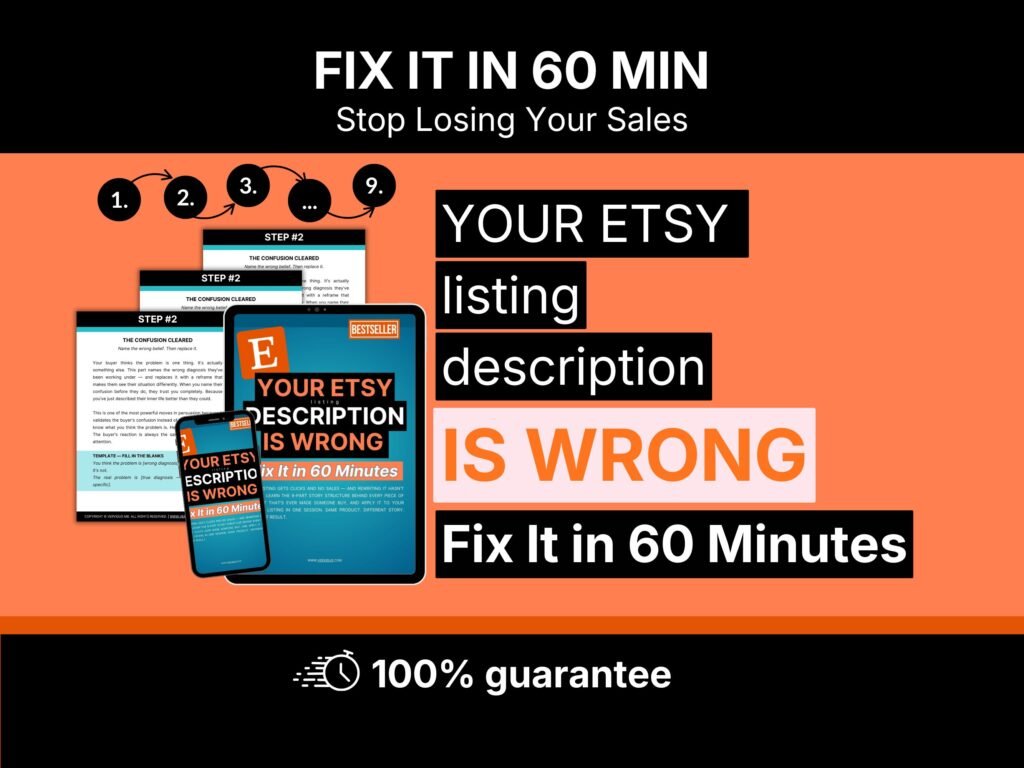
The Listing Description Guide — 9 Parts, One Evening, One Listing Fixed
The Listing Description Guide is a 44-page Etsy listing description template for sellers whose listings get views and no sales. It takes the 9-part story structure behind every ad, product page and launch that has ever made someone buy, and turns it into nine fill-in templates you complete for your own product — in order, with worked examples, in about 60 minutes. You start by duplicating the listing, so the one that already ranks is never at risk. Built from 11 years in e-commerce and seven years selling on Etsy.
The problem isn’t that nobody can find you.
They found you. That’s what makes this so maddening.
You have views. Favorites, even. People are landing on the listing, reading it, and leaving — and every guide you open wants to talk to you about tags and photos and listing more items, as if the problem were traffic. It isn’t. You solved traffic weeks ago.
One seller put it better than any marketing copy I could write: customers are finding my work just fine, but aren’t buying it.
So you rewrote it. Changed the title. Added keywords. Watched the videos. You open your stats every morning, and the number that matters doesn’t move — and worse, you have no way of knowing whether anything you changed did anything at all. As another seller asked last month, half-joking: do you just wait for sales to increase?
That’s the actual problem. Not that you’re lazy. Not that you’re bad at writing. You have been working blind.
Why does this cost less than a coffee?
Because I don’t make my living selling $2 PDFs. I make it selling online, and I have for eleven years.
This guide is the front door of my shop, not the business behind it. I’d rather you spend the price of a coffee finding out whether the way I think is useful than take my word for it.
If it helps, you’ll come back. If it doesn’t, you’re out less than a coffee.
And here’s the part worth saying out loud: you have already spent far more than $2 on this problem. Two hours rewriting. The evenings you opened the listing and closed it again. The sales that went to a shop selling the same thing as you, with worse photos and better words. That’s the real price you’ve been paying. This is 60 minutes.
The one thing wrong with your description
It’s not that it’s too short. It’s not that it needs more keywords.
Your description is talking about your product. It should be talking to your buyer.
Your buyer lands on the listing with one question in her head: what do I get from this? Every word that doesn’t answer it is a word that makes her leave. And most Etsy descriptions are made almost entirely of those words:
Hand-crafted with love. Premium quality materials. Perfect for anyone who loves…
A seller who spent six months working out why his shop wasn’t selling named this perfectly. He called it verbal wallpaper — the sentences every seller writes that say nothing, that create zero emotion. Nobody has ever bought anything because of them.
That’s what the nine parts are for. Not “write better copy.” A structure, in order, that replaces filler with the specific things a buyer needs to hear to decide.
“I’m terrified to touch anything on it.”
That’s a real seller on Reddit, ranking on page one and too frightened to edit her own description. The replies told her not to. One said simply: never change a listing that’s working — I speak of regret.
I take that fear seriously, because it’s rational. So the guide doesn’t start with writing. It starts with this:
Duplicate the listing. Work only on the copy.
Your original stays exactly where it is, ranking exactly as it does. You build the new description on the duplicate, publish it, and compare the two against your own stats. You test. You lose nothing.
It’s the same method experienced sellers share when someone asks. It’s page 5 of the guide, before you write a single word.
Nine parts. Each one does a job on the reader.
The first three earn the right to be read. Someone lands on your listing suspicious and in a hurry, half-deciding to leave before they’ve finished the first line. These parts stop the right person, let the wrong one go, and make the right one feel like you’ve been standing behind them the whole time they were shopping.
The middle three make buying feel small. Most descriptions pile on features until the decision starts to feel like work — and a decision that feels like work gets postponed. These do the opposite. One shift. One reason. One thing to be against. This is where someone browsing quietly turns into someone who wants it.
The last three close. A before-and-after set side by side, the objection nobody ever types into the message box, and a final line with no escape hatch — because “feel free to add to cart whenever you’re ready” is how a sale dies politely.
You don’t need to work out which part your listing is missing. You go through them in order, and the gaps announce themselves.
Every part has a fill-in template, step-by-step instructions, the common mistakes for that part, and a write-here page. The finished description builds itself as you go — you don’t reach the end and face a blank box.
Three worked examples run through the whole book: a candle, an apron, a wedding invitation. You see the logic on someone else’s product before you apply it to yours.
What you get (instant download)
- The Listing Description Guide (PDF, 44 pages) — nine parts, nine write-here sections, plain English for readers who work in English but didn’t grow up speaking it.
- A fill-in template for every part — you fill in the blanks. You are not asked to write from scratch.
- Common mistakes for each part — so you can see them coming.
- Three worked examples — physical, wearable, digital.
- Bonus: your title — the 140-character formula, five rules.
- Bonus: your 13 tags — four research sources, including the competitor source-code method.
- Bonus: your shop announcement — three sentences, for Etsy, Linktree, or anywhere you promote off Etsy.
- Bonus: the Etsy SEO Checklist — 18 checkpoints. Free, via a link inside the guide.
- Bonus: the 5-minute Bottleneck Diagnostic — before you rewrite anything, check whether the description is even your real problem. Free, via a link inside the guide.
Works on any device. No installation, no subscription. Print the write-here pages and work on paper.
The One Listing Promise
Rewrite one listing using the nine parts. Give it 30 days.
Then open your Etsy stats and compare that listing against the 30 days before it. If nothing moved, send me the before and the after within 60 days. I’ll refund you — and I’ll rewrite the description myself and tell you what I changed and why.
I answer these personally, so I take a limited number each month. But I do answer. You risk one evening.
This is not an Etsy SEO guide
You’ve seen the ones I mean — rank #1 in 7 days, the algorithm hack nobody’s talking about. This isn’t that.
There’s nothing here about tags, titles, or the algorithm as a way to get found, because being found isn’t your problem. This is about the words on the page after she arrives. If your listing genuinely has no traffic, this is the wrong tool, and I’d rather tell you now — start with the Etsy SEO Checklist instead.
And there’s no income promise, because nobody can honestly make one.
Fix the listing, or start a new one?
This comes up constantly, and the answers you’ll find are split down the middle, which is exactly why it keeps people stuck.
My answer: fix one. Not the shop. Not all of them. One listing that gets views and no sales, duplicated first so nothing is at risk. If the rewrite moves that listing, you’ve learned something true about your buyer that applies to every other listing you own. If you start over instead, you learn nothing, and you’re four evenings poorer.
Who this is for
Sellers who already have listings up and traffic coming in — a few sales a month, a full-time job, and a shop that won’t move past where it is.
It is not for people who haven’t published yet. If there’s no listing to fix, start with the Etsy Shop Audit Checklist instead.
Frequently asked questions
How do I write an Etsy listing description that sells?
Write the first two lines for the buyer’s decision, not for your product. Open with a specific situation or result she recognizes, name the wrong belief she’s working under, then reflect her actual experience back to her before you describe anything you made. Etsy weights the opening of the description in search, and it also decides whether she keeps reading. The nine parts in this guide follow that sequence.
Why does my Etsy listing get views but no sales?
Views mean your title and tags are working — buyers are finding you. No sales means something on the page is losing them, and for most listings, the description is the first suspect, because it’s usually written about the product rather than to the buyer. Rewrite one listing and compare it against its own previous 30 days before changing anything else.
Will changing my description hurt my ranking?
Not if you duplicate the listing first and edit the copy. That’s step one of the guide, before you write anything. Your original keeps its position while you test the new version against it.
Can I type my answers into the PDF?
No. This is a print-and-write guide — print the write-here pages and fill them in by hand. There are no on-screen form fields.
Do I need any special software?
No. It’s a PDF that opens in any reader or browser. No account, no subscription, nothing to install.
Does this work for digital products, or only handmade?
Both. The structure describes how a person moves from stranger to buyer, which doesn’t change by category. The three worked examples cover a physical product, a wearable, and a digital template on purpose.
English isn’t my first language. Can I still use this?
Yes. Every part is a fill-in template with the sentence structure already built. You supply the specifics about your product; the guide supplies the phrasing.
I bought this on Etsy — is this the same product?
The guide is the same. This edition comes with the full One Listing Promise, and it’s where updates land first.
About Vervidus
Vervidus makes practical tools for small online shops and the people trying to start one — checklists, trackers, and guides built around the questions that actually stall people, not the ones that make good headlines. Every tool draws on 11 years of hands-on e-commerce across Etsy, Shopify, Amazon, WooCommerce, and Wix, and every one is built the same way: ranked, practical, and sized to fit real evenings. Vervidus products hold a real 4.9★ rating on Etsy. Based in the EU, made for sellers in the US, UK, EU, and Canada. Behind Vervidus is one person with 11 years in e-commerce — not an agency, not a content farm.
Not ready to buy? Take the free 5-minute Bottleneck Diagnostic and check whether the description is really what’s holding your shop back.