The Decision Guide — 80 Ways
to Start Online, Narrowed Down to Your One
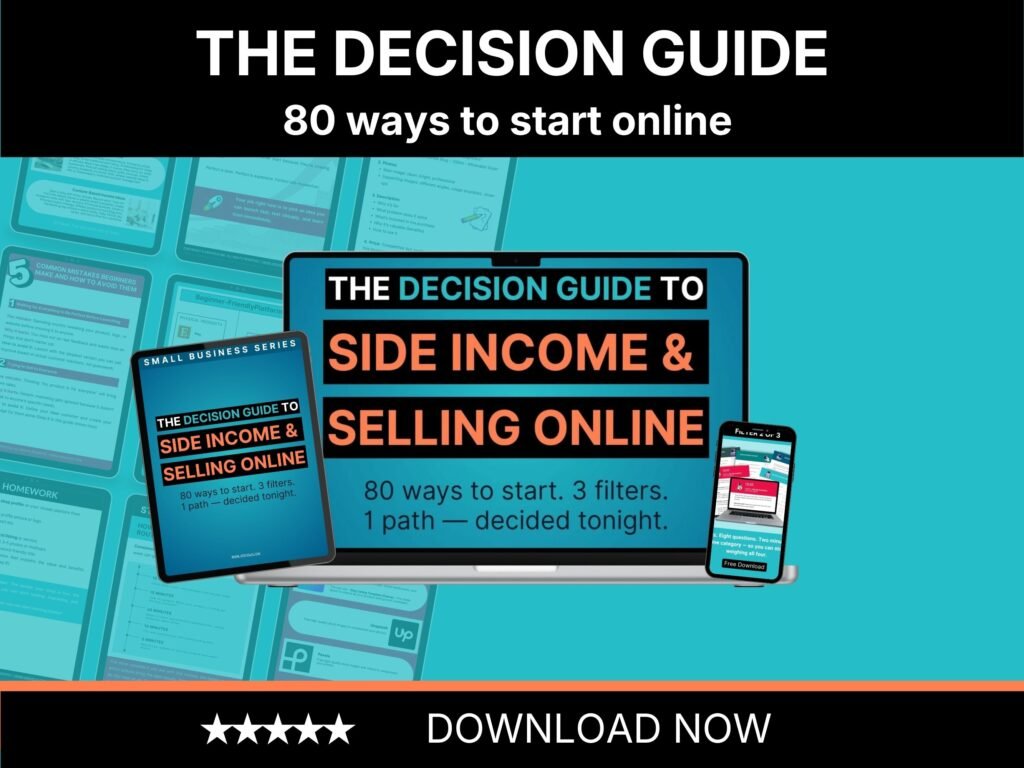
The Decision Guide is a 57-page PDF for people who want to start an online business and can’t decide which one. It puts 80 real options on the table — 40 business models and 40 quick-start ideas across physical products, digital products, services and content — then runs them through three filters until one is left: your number and your hours, your category, and real demand. Nine steps, a short worksheet after each, and a final page where you write down your path, your first idea, and the hours you’ll give it. Built from 11 years in e-commerce across Etsy, Shopify, Amazon, WooCommerce, and Wix.
You are not short of ideas. That’s the problem.
You’ve saved the videos. You’ve read the lists — 37 side hustles you can start this weekend. You have a notes app full of them.
And every evening ends the same way: you could start almost anything, so you start nothing.
That isn’t laziness, and it isn’t a discipline problem. It’s what happens when every option is still open at 9 pm on a Tuesday, and you have one hour before bed. Physical or digital? A service, or content? What if I pick wrong and waste six months?
So this guide does the opposite of every free list you’ve read. It doesn’t hand you more ideas. It hands you eighty — and then takes seventy-nine away.
Why does this cost less than a coffee?
Because I don’t make my living selling $2 PDFs. I make it selling online, and I have for eleven years.
This guide is the front door of my shop, not the business behind it. I’d rather you spend the price of a coffee finding out whether the way I think is useful to you than take my word for it. You can check the claim before you buy: seven years on Etsy, 1,100+ sales, a real 4.9★.
If it helps, you’ll come back. If it doesn’t, you’re out less than a coffee. That’s the whole arrangement — and I’d rather say it plainly than pretend this is a $60 course I’m heroically discounting.
What’s inside — 80 options, 3 filters, 1 answer
No 100-idea lists. No “it depends.” Every option goes through the same three gates, in order, so you always know what you’ve ruled out and why.
Filter 1 — Your number and your hours (Step 1)
Before you look at a single idea, you set two numbers: what you need to earn, and the hours you actually have. Not the hours you wish you had — the real ones, at 7:30 pm after the kids are down. Most of the eighty options disqualify themselves right here, because they cannot get you to your number in the time you’ve got. That’s not a disappointment. That’s the list getting shorter.
You pick from a ladder built for real life: $300/month to breathe easier, $700 to cut hours at work, $1,500 to go full-time. Not six figures. Numbers you can believe on a Tuesday.
Filter 2 — Your category (Step 2 + the quiz)
The four ways to earn online — physical products, digital products, services, content — with the honest cons of each, not just the pros. Forty business models laid out so you can see exactly what you’re saying no to. Then eight questions, two minutes, and you have one word: physical, digital, services, or content.
Filter 3 — Real demand (Step 4)
Four ways to check whether anyone is actually paying for your idea — Amazon best-sellers, Etsy filters, Google Trends, Pinterest and TikTok — before you spend a single evening building it. Whatever survives this filter is worth your evenings.
Then Steps 5 to 9 build the thing you chose: platform, offer, shop, promotion without ads, and a one-hour weekly routine that stops you quietly drifting away in month three.
The One Rule: you leave with one path, not a shortlist
A shortlist feels like progress. It isn’t — it’s the same paralysis with fewer options.
So the guide ends at Your One Decision Page: three lines, filled in by hand. Your path. Your first idea. Your hours. If you can’t fill in all three, one of the filters needs another pass, and the page tells you which one.
That’s the whole job. Not a business plan. A decision.
This is not a “make money online” guide
You’ve seen the ones I mean — $200 a day, passive income while you sleep, faceless reels. This isn’t that, and I’d rather lose the sale than let you find out after you’ve paid.
There is no income promise here, because nobody can honestly make one. What’s here is a method for choosing, and a routine for staying with what you chose. The idea matters far less than whether you stay with it — that’s the actual lesson of eleven years, and it’s the one nobody puts on a sales page.
The smart first step before you spend money on a course
Thinking about a course? Do this first.
Courses teach you how to run a business model. They can’t tell you which one fits your life, your hours, and your number — and if you pick the wrong one, the course was money spent teaching you something you’ll abandon by spring. Make the decision first, cheaply. Then spend money on the thing you actually chose.
What you get (instant download)
- The Decision Guide (PDF, 57 pages) — nine steps, eight short homework tasks, written in plain English for readers who work in English but didn’t grow up speaking it.
- 80 starting options — 40 business models and 40 quick-start ideas, across all four categories, so you can see the full board before you clear it.
- Your One Decision Page — the fill-in page that ends the search.
- When You Feel Stuck, Keep Going — a page to come back to on the weeks it stops feeling worth it. It’s the most honest page in the guide.
- 15 named tools, grouped by job, free options first — so the tool decision is already made.
- 5 beginner mistakes, named, so you can see them coming.
- Bonus: the 2-Minute Path Finder Quiz — 8 questions, one clear category. Free, via a link inside the guide.
Works on any device. No installation, no subscription. Print the worksheet pages and write by hand.
The One-Evening Decision Guarantee
Work through Steps 1 to 4 — about one evening.
If you finish and still can’t name the one path you’re starting and the first idea you’ll test, email me your One Decision Page within 60 days. I’ll refund you — and I’ll read what you wrote and tell you which path I’d pick for your situation, and why.
I answer these myself, so I take a limited number each week. But I do answer. You risk nothing but one evening.
Who this is for
People at the very start — before a shop exists, before anything is listed — who have a full-time job, a few free evenings, and a realistic goal of a few hundred a month to begin with.
It is not for people already selling. If you have listings and want more sales from them, this is the wrong tool, and I’d rather tell you now: start with the Etsy Shop Audit Checklist instead.
Frequently asked questions
How do I decide what online business to start?
Work in this order: set your income target and the hours you genuinely have, pick one of the four categories that fits that reality, then test your shortlist against real demand before building anything. Most people do it backward — they pick an exciting idea first and discover the time cost later. This guide runs the three filters in order.
What’s the easiest online business to start with no experience?
Services are usually fastest to first payment because you’re selling a skill you already have, with no inventory and no up-front build. Digital products scale better but need creation work before anything sells. There’s no universally easiest one — the right answer depends on your hours and your target, which is what Filter 1 works out.
Should I sell physical or digital products?
Physical products have a huge built-in audience on marketplaces but cost you inventory, production, and shipping time. Digital products need no inventory and scale without extra work, but require up-front creation and marketing to stand out. If your free time is the scarce resource, that usually points to digital. Step 2 lays out the honest cons of both.
How much can I realistically make from a side hustle?
In the first year, working evenings around a job, a realistic target is a few hundred a month rather than a full-time income. The guide uses $300, $700, and $1,500 a month as milestones because those are numbers people actually hit — and picking one that’s too high is a common reason people quit at month four. I broke those numbers down properly here — what $300, $700, and $1,500 a month look like as actual sales per day: How much can you realistically make from a side hustle?
Can I type my answers into the PDF?
No. This is a print-and-write guide — you print the worksheet pages you need and fill them in by hand. There are no on-screen form fields.
Do I need any special software?
No. It’s a PDF that opens in any reader or browser. No account, no subscription, nothing to install. You’ll want a printer for the worksheet pages — about ten pages of the 57. The rest is for reading, on any device.
I bought this on Etsy — is this the same product?
The guide is the same. This edition comes with the full One-Evening Decision Guarantee, and it’s where updates land first.
About Vervidus
Vervidus makes practical tools for small online shops and the people trying to start one — checklists, trackers, and guides built around the questions that actually stall people, not the ones that make good headlines. Every tool draws on 11 years of hands-on e-commerce across Etsy, Shopify, Amazon, WooCommerce and Wix, and every one is built the same way: ranked, practical, and sized to fit real evenings. Vervidus products hold a real 4.9★ rating on Etsy. Based in the EU, made for sellers in the US, UK, EU, and Canada. Behind Vervidus is one person with 11 years in e-commerce — not an agency, not a content farm.
Not ready to buy? Take the free 2-minute Path finder Quiz and find your category first.