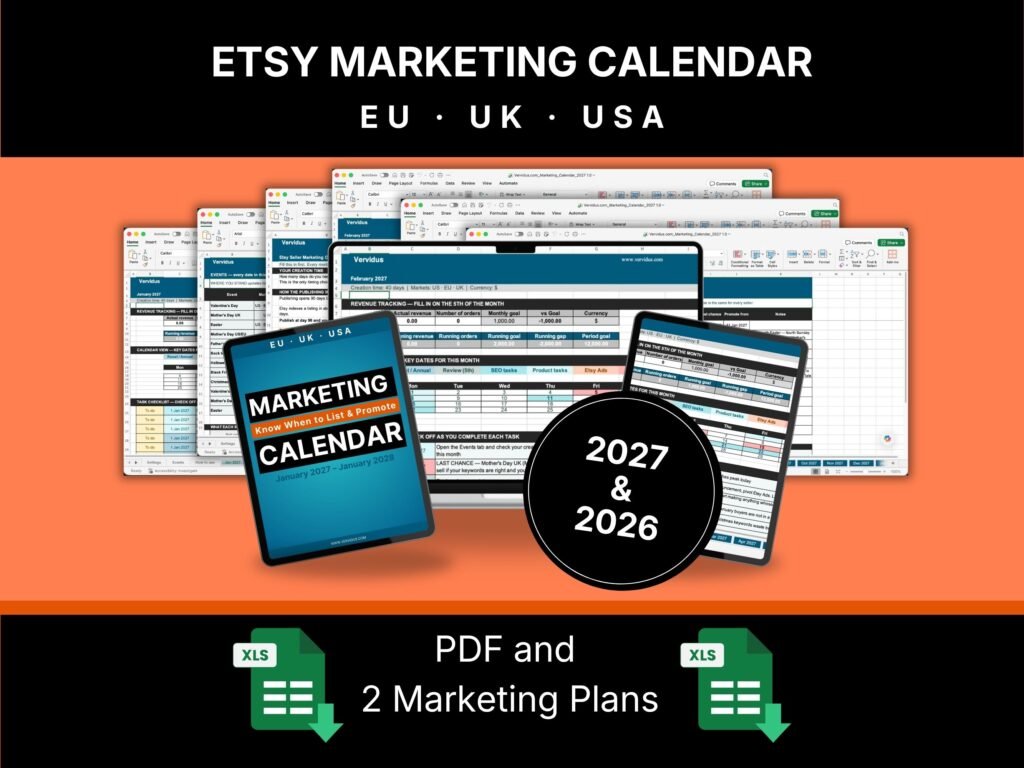
The Etsy Marketing Calendar is a 13-month planning system for digital product sellers, covering January 2027 through January 2028. It is a Google Sheet and a short guide. You enter one number — how long you need to make a product — and the file calculates the start date for every seasonal event in the period, then shows where you stand on each one every time you open it. Built for sellers in the US, UK, and EU by someone with 11 years in e-commerce.
You are not behind because you work too little
You are behind because you started in the wrong month.
You listed Valentine’s products in February. Christmas products in November. And by the time your listing appeared in search, someone else had already sold to your buyer.
This is not a work problem. You worked. You made the thing, wrote the title, picked the tags, and posted about it. The work was fine.
The timing was wrong, and nobody ever told you what the right timing was.
A seller posted this a few weeks ago, about her own shop:
Am I too late? Should I just jump straight to Christmas?
She sells digital wall art. She asked about Halloween in August, and she genuinely didn’t know whether the season was still worth trying — so she was thinking about skipping it entirely.
That is what the last few years have looked like for you too. Not laziness. Not bad products. Just no way to tell whether you are early, on time, or already finished.
Why does this cost less than dinner?
Because I do not make my living selling calendars.
I have sold online for eleven years — on Etsy, Shopify, Amazon, WooCommerce and Wix. This is the front door of my shop, not the business behind it. I would rather you spend a small amount finding out whether the way I think is useful than take my word for it.
There is a second reason, and it is more honest than most sales pages will be with you.
A calendar has a shelf life. This one covers January 2027 to January 2028. Every month that passes, it is worth less. Pricing it as if it lasts forever would be a lie, because it does not.
And here is the part worth saying out loud: you have already paid far more than this for the same problem. One missed season. One quarter where the listing went live too late. The evenings you spent making something nobody found in time.
That is the real price you have been paying.
The one thing wrong with how you plan
You are planning from the holiday backward.
Christmas is December 25, so December feels like Christmas month. That is how a calendar reads, and it is why every seasonal calendar you can buy is useless — it tells you the date of the event, which you already knew.
Here is what nobody puts on the page.
Etsy does not rank a new listing on the day you publish it. There is a delay. It is real, it is measurable, and it is the same for every seller on the platform. During that delay, your listing is not competing. It is being assessed.
So the date that matters is not the holiday. It is the date after which publishing is too late to be ranked in time — and that date is nowhere near the one you have been working to.
There is a date in autumn after which your Christmas listings cannot rank before Christmas. Most sellers publish weeks after it every year, then wonder what went wrong in December.
This calendar is built entirely around that gap. The guide explains exactly why the dates fall where they do, so you don’t have to trust me — you can check the reasoning yourself and decide.
Nobody can tell you whether you are behind
“I’m trying to determine if I’m behind or not”
That is a real seller, in her own words, asking a forum full of strangers.
It is the single most common question in Etsy seller communities; it gets asked every year in every season, and it never gets a real answer. The replies are always the same pile of contradicting guesses. List in July. List in September. Leave them up all year.
Nobody has a system. So everyone guesses, and everyone assumes the sellers doing better than them know something they do not.
They do. It is timing.
When you open this file, one column answers that question for every event in the year, at a glance. Not a rule of thumb. Not “plan ahead.” Where you actually stand today, on each one, updated every time you open it.
You will be on time for some. You will be late for others. That is normal, and the file says so plainly instead of pretending.
It tells you the truth about a window you missed
This is the part no competitor will give you.
Every other calendar assumes you are on time. When you are not, it simply stays quiet, and you find out in December.
This one tells you. If a window has closed, it says so, and it tells you what your remaining odds actually look like — honestly, without dressing it up as a plan.
Then it does the more useful thing: it stops you trying to rescue five events at once. One event done on time beats four done late. The file helps you choose which one.
I would rather you knew in March than found out in December.
Timing fails in two directions
Being late is one problem. Being buried is the other, and it is the one that makes people quit.
A seller with a full-time job wrote this after her first real Q4:
I wasn’t expecting this and I didn’t prepare.
She had been averaging twenty orders a month. November brought 172. She stopped sleeping properly, stopped cooking, and stopped enjoying any of it.
Her listings worked. That was the problem. Nothing had told her what was coming, so she had booked no time off and lined up no help.
Every month in this calendar tells you what to expect, so you can plan your hours and not only your listings.
What you get (instant download)
- The 2027 Marketing Calendar (Google Sheet) — 13 monthly tabs, January 2027 to January 2028. One tab per month, each one holding only that month’s work. Nothing sends you back to a page you already finished.
- Window alerts by email — I email you when each listing window opens and again a week before it closes, so the calendar comes to you instead of you having to open it. Optional, and you can stop them anytime.
- A live view of every event in the year — one column telling you where you stand today on all of them, without you updating anything.
- Your own dates — enter one number about how you work, and every start date in the file adjusts to your shop.
- Revenue tracking that carries across the year — monthly targets calculated from a single goal you type once, with running totals so you can see whether you are actually on the path you wanted.
- Market labels for US, EU, and UK — so you stop losing whole seasons in markets you did not know had them, and skip the ones that are not yours.
- The guide (PDF, 16 pages) — why the dates fall where they do, written to be read once in ten minutes, not studied.
- Bonus: the Etsy SEO Checklist — 18 checkpoints. Timing only works if people can find the listing once it is live.
- Bonus: the 5-minute Bottleneck Diagnostic — check whether timing is even your real problem before you change anything.
- Bonus: Is Your Niche Holding You Back? — eight questions, two minutes.
Works in Google Sheets or Microsoft Excel. Both are free to use. No account with me, no subscription, nothing to install.
You do not have to wait until January
The 2027 calendar opens in January. It is not January.
So this comes with the Q4 2026 Sprint Calendar — September to December 2026 — built the same way, with the same live column showing where you stand.
Halloween. Black Friday. Christmas. This year, not next year.
Your Halloween 2026 listings need to be live by September 1. Black Friday opens August 29. Christmas opens September 26. All three are in the Q4 file, with your dates.
The Name-The-Date Promise
Most guarantees are noise. Here is one you can actually check.
Open the file. Enter how long you need to make a product.
It must then give you a specific start date for every event in the calendar — plus the date publishing opens, the date it closes, and your last chance.
If it does not — if any event leaves you without a date — email me within 60 days with a screenshot. You get a full refund, and you keep every file, including the bonuses.
I am not asking you to prove it did not work. I am not asking to see your sales. I promise one thing: it either does it, or it doesn’t.
I answer these personally. Every one.
This is not a holiday calendar
You have seen those. A list of dates telling you Christmas is in December and Valentine’s Day is in February.
You already knew that. Knowing the date of the holiday has never once been your problem.
There is also no income promise here, because nobody can honestly make one. I cannot promise you sales. I can promise you a date, which is why the guarantee above is about dates and nothing else.
And it is not a social media system. If you would rather not spend your life posting, you are in the right place — the content side of this is small, dated, and finite. Post on the days that matter, and stop.
If you are not sure which channel deserves those posts in the first place, the Social Media Audit scores each one out of 12 and names the one worth your evenings. Post on the days that matter, on the channel that pays you back.
Who this is for
Sellers who already have listings up and some sales coming in. A few a month, a full-time job, a shop that will not move past where it is.
You are aiming at something real — $1,000 to $3,000 a month, consistently — and every guide you open is written either for someone who has never listed anything, or for someone already making $30,000 a month. Neither of them is you.
It is not for people who have not published yet. If there is nothing live in your shop, timing is not your problem, and this is the wrong tool. Start with the Etsy Shop Audit Checklist instead.
Frequently asked questions
When should I list seasonal products on Etsy?
Much earlier than most sellers do — and considerably earlier than the month of the event. A new listing isn’t visible in search the day you publish it, and it takes time to hold a stable position. That means the useful listing date sits well ahead of the season, and it varies depending on how long it takes to make a product. This calendar calculates that date for your shop and gives you a window to work in rather than a single day to hit.
Why do my seasonal listings never seem to rank in time?
Because they were published too close to the event. A new Etsy listing goes through a period of assessment before it’s ranked. Publish during that period, and the season passes while you are still being evaluated. The fix isn’t better keywords — it is an earlier publish date, and the guide explains exactly why.
Do I need any special software?
No. The calendar works in Google Sheets (free) or Microsoft Excel. The guide is a PDF that opens in any browser or reader. No installation, no subscription, and no account with me.
What if I buy mid-year?
Start with the current month and work forward. Each month works on its own — you don’t need to have used January to use August. The live column shows where you stand on every event the moment you open the file, no matter the date.
Does this work if I sell physical products?
The timing logic works for physical products too, and the seasonal dates are the same. It was built for digital sellers, so it does not cover materials, stock, or shipping deadlines. If you sell handmade physical goods, you will want to add your own production time on top.
Which markets does it cover?
The United States, the European Union, and the United Kingdom. Every task is labeled by market, so you can act on the ones that apply to you and ignore the rest. This matters more than sellers expect — several major gifting dates fall on completely different days in the UK than in the US.
Will it tell me what to post on social media?
It tells you which days matter and what each one is for. It will not hand you captions or turn you into a content creator. If you would rather not build an audience, the calendar still works — posting is one small part of it, not the point.
Is anything shipped to me?
No. This is a digital download. You get the files immediately after payment, and nothing arrives in the post.
I bought this on Etsy — is this the same product?
Only partly. The calendars and guide are the same. This edition adds the Name-The-Date Promise and the listing window alerts, and it is where updates land first.
Can I get a refund on a digital download?
Yes, under the promise above: if the file does not give you the dates it says it will, email me within 60 days, and I will refund you and let you keep everything. If something simply doesn’t work, message me first; I would much rather fix it for you than read about it later.
License
Use the calendar and the guide for your own shop as much as you like, on any platform. You can’t resell, share, or redistribute the files or their contents, and you can’t sell them as your own product.
About Vervidus
Vervidus makes practical tools for small online shops and the people trying to start one — checklists, trackers, and guides built around the questions that actually stall people, not the ones that make good headlines. Every tool draws on 11 years of hands-on e-commerce across Etsy, Shopify, Amazon, WooCommerce, and Wix, and every one is built the same way: ranked, practical, and sized to fit real evenings. Vervidus products hold a real 4.9★ rating on Etsy. Based in the EU, made for sellers in the US, UK, and EU. Behind Vervidus is one person with 11 years in e-commerce — not an agency, not a content farm.
Not ready to buy? Take the free 5-minute Bottleneck Diagnostic and check whether timing is really what is holding your shop back.