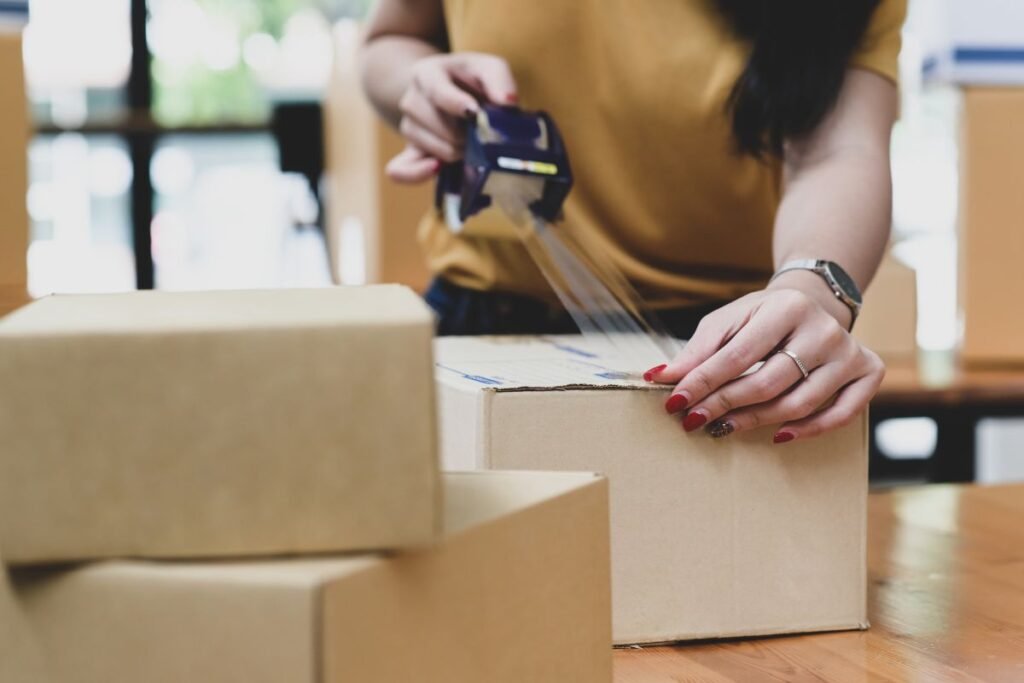
Most handmade sellers know what postage costs. Far fewer know what the parcel costs—the mailer, the tape, the tissue, the thank-you card, the sticker you throw in because it is nice. You buy those in packs, months apart, and never divide them across the orders they go into. This post shows you how to work out both numbers, using arithmetic you can do on the back of an envelope, and what to do once you know.
Free shipping is never free
That is not my line. It is what a seller wrote in a forum thread, and it is the shortest true thing anyone has said about this.
Free shipping is not a discount you give. It is a cost you absorb. Etsy pushes it because it lifts your search position, and it does—but you still pay the postage, and now you are the one paying it.
Your dashboard will not show you this. It shows what buyers paid. It does not show what the label cost. So the gap sits there, one order at a time, invisible.
The math nobody does
Here is a real example from a seller working out her own numbers.
She sells bookmarks. An order of three came to $10.58 after fees. Postage was $7.80.
That leaves $2.78 for three bookmarks—about 92 cents each. Then she added, almost as an afterthought, that this was before the envelope, the thank-you card, and the free sticker.
Add maybe 60 cents for those, and she is under $2.20 on the order. On materials and an hour of making.
She had done this math. She knew. What she didn’t have was the total across a year, which would have told her to change something.
Work out your packaging cost per order
This takes ten minutes, and you only do it once.
List what goes into a typical parcel. For most shops: a mailer or box, tape, tissue or filler, a thank-you card, maybe a sticker or ribbon.
For each one, take the pack cost divided by how many are in it.
A hundred kraft boxes for $46 is 46 cents a box. A hundred sheets of wrapping paper for $24 is 24 cents a sheet—and if you use two, that is 48 cents. A roll of tape at $4 covering roughly 80 parcels is 5 cents. Thank-you cards at $18 for 100 cost 18 cents each.
Add them up. That is your packaging cost per order.
For the shop above, that is about $1.17 a parcel. Not enormous. But over 300 orders in a year, it is $351—and it appears nowhere in the price.
The things you cannot divide
Some things resist this. Twine is the example I always come back to.
You cannot sensibly work out how much twine goes into one parcel. You could weigh it, but you’d spend twenty minutes to find out something worth three cents.
So do not. You know roughly that a pack of twine lasts three months. That is enough. Log the pack when you buy it, note that it lasts about a quarter of the year, and move on.
The point is not perfect allocation. The point is that the money is visible somewhere instead of nowhere.
Are you overpaying for postage?
This one is worth an afternoon, because the savings repeat on every order.
There is a forum thread titled “I feel so dumb—I’ve been overpaying for shipping.” The seller had been buying labels at $7 to $10 that should have cost around $5. Another commenter replied that he had done the same for over a year before noticing.
The usual causes are simple:
Your weights are guesses, rounded up. Weigh a finished, packed parcel on a kitchen scale. Actually weigh it.
Your dimensions push you into a higher bracket. This is where small changes pay. A slimmer envelope, one less card, a lighter filler—sometimes removing a single item drops you a bracket and saves a couple of dollars on every order after that.
Your rates are out of date. Sellers report carriers raising prices three times a year now. A shipping calculation you did in January is probably wrong by July.
What to do with the answer
Once you know your packaging cost per order and what postage actually runs, you have three choices, and all of them are better than not knowing.
Raise the price—by the amount you are absorbing, not by a guess. Buyers rarely notice a dollar. They do notice a shop that quietly goes out of business.
Change the parcel. Lighter mailer, fewer inserts, a different filler. This is where the “remove one postcard” saving lives.
Keep absorbing it, on purpose. Free shipping genuinely does help your search position. Absorbing $1.17 a parcel as a marketing cost is a legitimate decision—as long as it is a decision, and not something happening to you.
Seeing the yearly total
The per-order math above is the hard part, and now it is done.
What is harder to hold in your head is the total—what postage, packaging, and fees added up to across a year, and how that compares to what buyers actually paid toward shipping.
That is what I built the Handmade Business Spreadsheet for. Postage and packaging get their own categories, and what buyers paid toward shipping sits next to what shipping cost you, so you can see which one is bigger. It comes with five months of a real handmade shop already filled in.
It costs $2 because it is a spreadsheet, and copying it costs me nothing.
You can do all of this in a blank sheet if you prefer. The tracker just means you do not have to build it.
Want the bigger picture first? I wrote a walkthrough on how to work out whether your shop is profitable at all: Am I Making Money on Etsy?
Frequently asked questions
How do I calculate packaging costs per order?
Divide each item’s pack price by how many are in the pack, then add up everything that goes into one parcel. A hundred boxes at $46 is 46 cents each; a hundred thank-you cards at $18 is 18 cents. For things you cannot divide sensibly, like tape or twine, estimate how long a pack lasts and log the pack when you buy it.
Am I losing money on free shipping?
You cannot tell from your Etsy dashboard, because it shows what buyers paid toward postage, not what your labels cost. Track both for one month and compare. Many sellers find the two are closer than expected, while others find shipping quietly takes a large share of their profit.
Should I charge shipping or build it into the price?
Both work. Free shipping helps your Etsy search position, which is why sellers use it, but the postage still comes out of your margin. The real mistake is choosing without knowing the number. First, work out what you absorb per order, then decide whether the search benefit is worth it.
How do I stop overpaying for postage?
Weigh a packed parcel rather than estimating, and check whether your dimensions are pushing you into a higher bracket. Small changes matter: a slimmer envelope or one less insert can drop you a bracket and save a couple of dollars on every order afterward.
Do packaging costs count as a business expense?
Yes. Boxes, mailers, tape, tissue, thank-you cards, and stickers are all costs your shop incurred. Whether they are deductible for tax purposes is a separate question for your accountant, but for working out your profit, they absolutely count—and they are the ones sellers most often leave out.
About Vervidus
Vervidus makes practical tools for small online shops and the people trying to start one—checklists, trackers, and guides built around the questions that actually stall people, not the ones that make good headlines. Every tool draws on 11 years of hands-on e-commerce across Etsy, Shopify, Amazon, WooCommerce, and Wix. Based in the EU, made for sellers in the US, UK, EU, and Canada. Behind Vervidus is one person with 11 years in e-commerce—not an agency, not a content farm.